
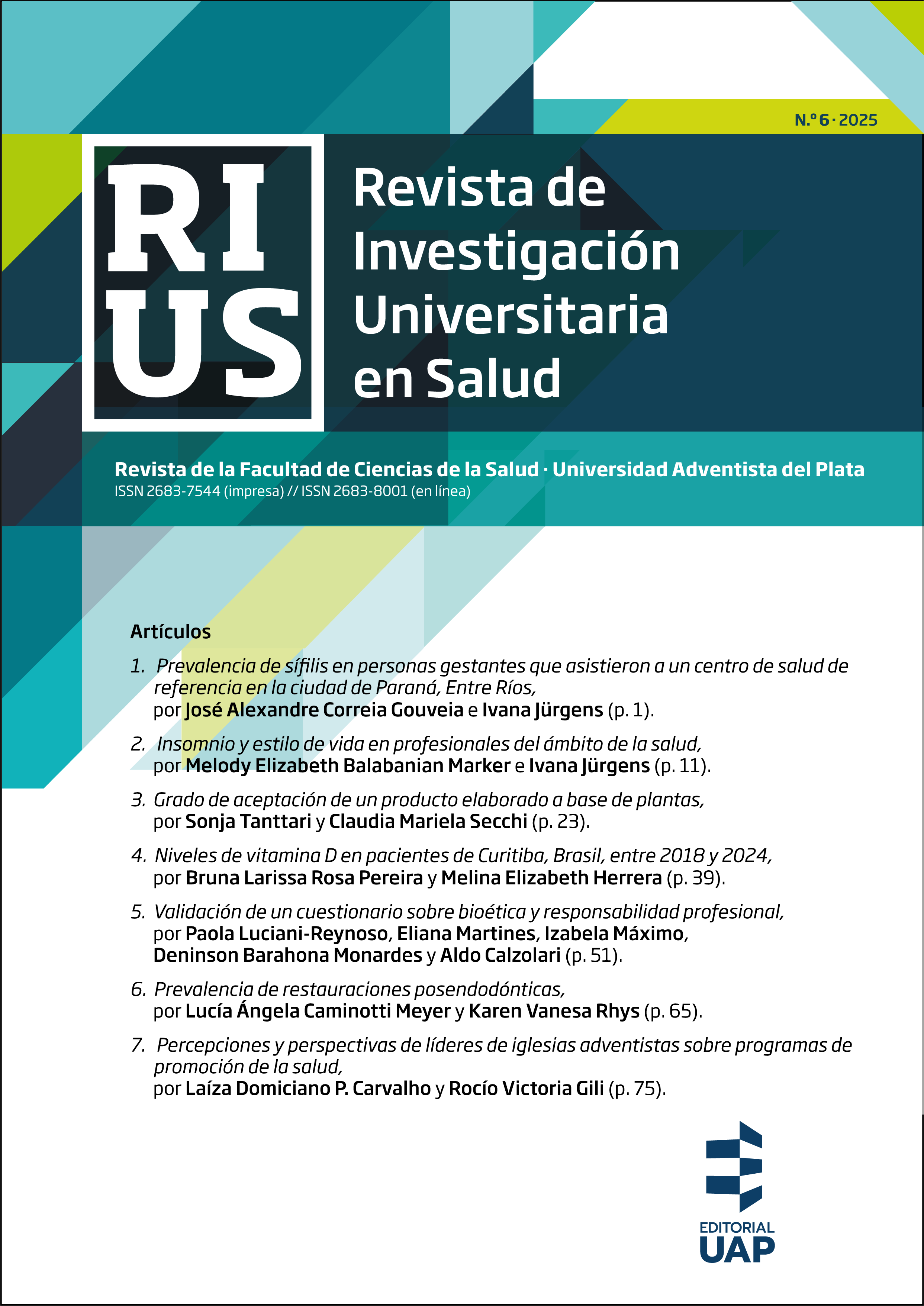
Perceptions and Perspectives of Seventh-day Adventist Church Leaderson Health Promotion Programs
DOI:
https://doi.org/10.56487/7cmamj29Keywords:
Lifestyle − Noncommunicable diseases − Health promotion − Religious organizations − Prevention and controlAbstract
Introduction. Chronic noncommunicable diseases (NCDs) result from a combination of genetic, environmental, and behavioral factors. To control them, it is important to reduce associated risk factors through interventions that can be carried out in primary care. Churches have proven to be effective settings for implementing health promotion and disease prevention programs and are recognized by public health as strategic partners. Population and methods. The study followed a qualitative design. Three leaders from Seventh-day Adventist churches in the province of Buenos Aires participated, selected though purposive sampling. In the first meeting, a semi-structured interview was conducted to explore their perceptions and perspectives on health promotion programs. The interviews were recorded, transcribed, and analyzed using content analysis. Additionally, virtual meetings were held, in which topics focused on NCDs prevention were addressed, promoting a healthy lifestyle. Results. The leaders expressed positive perceptions and perspectives regarding health programs. They identified diabetes and hypertension as the most prevalent NCDs. They also decided to create an interdisciplinary team with health professionals to address the needs of church members through quarterly meetings. Conclusion. The leaders showed a favorable disposition toward health programs and were willing to develop new projects addressing NCD prevention. The activities carried out by the Adventist churches in Los Polvorines generated positive visibility in the community and were acknowledged by the local municipality.
Downloads
References
Organización Mundial de la Salud. Enfermedades no transmisibles [Internet]. 2018 [actualizado el 23 de diciembre de 2024; citado el 1 de enero de 2025]. Disponible en: https://www.who.int/ es/news-room/fact-sheets/detail/noncommunicable-diseases#:~:text=Los%20principales%20 tipos%20de%20ENT,el%20asma)%20y%20la%20diabetes
Khemthong K, Turnbull N, Suwanlee SR, Peltzer K. The prevalence of alcohol and tobacco use associated risk factor of noncommunicable diseases in Si Sa Ket province, Thailand. Stud Health Technol Inform. 2020;270:1407-1408.
Pop TL, Namazova-Baranova L, Mestrovic J, Nigri L, Vural M, Sacco M, et al. The role of healthy lifestyle promotion, counseling, and follow-up in noncommunicable diseases prevention. J Pedia tr [Internet]. 2020 [citado el 1 de enero de 2025];217(1):221-223. Disponible en: https://doi. org/10.1016/j.jpeds.2019.10.061
Horton R. NCDs—Why are we failing? Lancet. 2017;390(10092):346.
Saha A, Alleyne G. Recognizing noncommunicable diseases as a global health security threat. Bull World Health Organ. 2018;96(11):792-793.
Modesti PA, Wang J, Damasceno A, Agyemang C, Van L, Persu A, et al. Indirect implications of COVID-19 prevention strategies on non-communicable diseases. BMC Med. 2020;18(1):1-16.
Azarpazhooh MR, Morovatdar N, Avan A, et al. COVID-19 Pandemic and burden of non communicable diseases: An ecological study on data of 185 countries. J Stroke Cerebrovasc Dis. 2020;29(9):105089.
Kluge HHP, Wickramasinghe K, Rippin HL, Mendes R, Peters DH, Kontsevaya A, et al. Prevention and control of non-communicable diseases in the COVID-19 response. Lancet. 2020;395(10238):1678-1680.
Lapuente M, Estruch R, Shahbaz M, Casas R. Relation of fruits and vegetables with major cardio metabolic risk factors, markers of oxidation, and inflammation. Nutrients. 2019;11(10): 23-81.
Martini D. Health benefits of mediterranean diet. Nutrients. 2019;11(8):1802.
Antunes R, Frontini R, Amaro N, et al. Exploring lifestyle habits, physical activity, anxiety and basic psychological needs in a sample of portuguese adults during covid-19. Int J Environ Res Public Health. 2020;17(12):43-60.
Organización Mundial de la Salud. ¿Qué es la promoción de la salud? [Internet]. 2016 [citado el 1 de enero de 2025]. Disponible en: https://www.who.int/features/qa/health-promotion/es/.
Glagola C, Wilcox S, Bernhart JA, et al. Church leaders’ views of obesity prevention efforts for children and youth. J Nutr Educ Behav [Internet]. 2020 [citado el 1 de enero de 2025];52(3):259 269. Disponible en: https://doi.org/10.1016/j.jneb.2019.09.019
Idler E, Levin J, Vanderweele TJ, Khan A. Partnerships between public health agencies and faith communities. Am J Public Health. 2019;109(3):346-347.
Draper CE, Tomaz SA, Zihindula G, Bunn C, Gray CM, Hunt K, et al. Development, feasibility, acceptability and potential effectiveness of a healthy lifestyle programme delivered in churches in urban and rural South Africa. PLoS One. 2019;14(7):1-28.
Sharpe PA, Wilcox S, Stucker J, Kinnard D, Bernhart J, James KL. Community health advisors’ characteristics and behaviors, role performance, and volunteer satisfaction in a church-based healthy eating and physical activity intervention. J Community Health. 2020;45(1):88-97.
Patton J, Thompson C, Bauer A, et al. A multilevel diabetes and CVD risk reduction interven tion in African American churches: Project faith influencing transformation (FIT) feasibility and outcomes. J Racial Ethn Health Disparities. 2020;10(1007):1-12.
Ayton D, Manderson L, Smith BJ, Carey G. Health promotion in local churches in Victoria: An exploratory study. Health Soc Care Community. 2016;24(6):728-738.
Fernández F, Yavich, N, Báscolo EP, Rodríguez G. Intervenciones poblacionales sobre enfermeda des crónicas no transmisibles en Rosario, Argentina. Rev da UIIPS. 2016;4(4):1-16.
Penn L, White M, Oldroyd J, et al. Prevention of type 2 diabetes in adults with impaired glucose tolerance: The European diabetes prevention RCT in Newcastle upon Tyne, UK. BMC Public Health. 2009;9(1):342.
Strandbygaard U, Thomsen SF. A daily SMS reminder increases adherence to asthma treatment: A three-month follow-up study. Respir Med [Internet]. 2010 [citado el 1 de enero de 2025];104(2):166-171.
Perri MG, Limacher MC, Durning PE, Janicke DM, Lutes LD, Bobroff LB, et al. Treatment of obesity in underserved rural settings (TOURS): A randomized trial of extended-care programs for weight management. Arch Intern Med. 2008;168(21):2347-2354.
Downloads
Published
Issue
Section
License
Copyright (c) 2025 Revista de Investigación Universitaria en Salud

This work is licensed under a Creative Commons Attribution-NonCommercial-ShareAlike 4.0 International License.