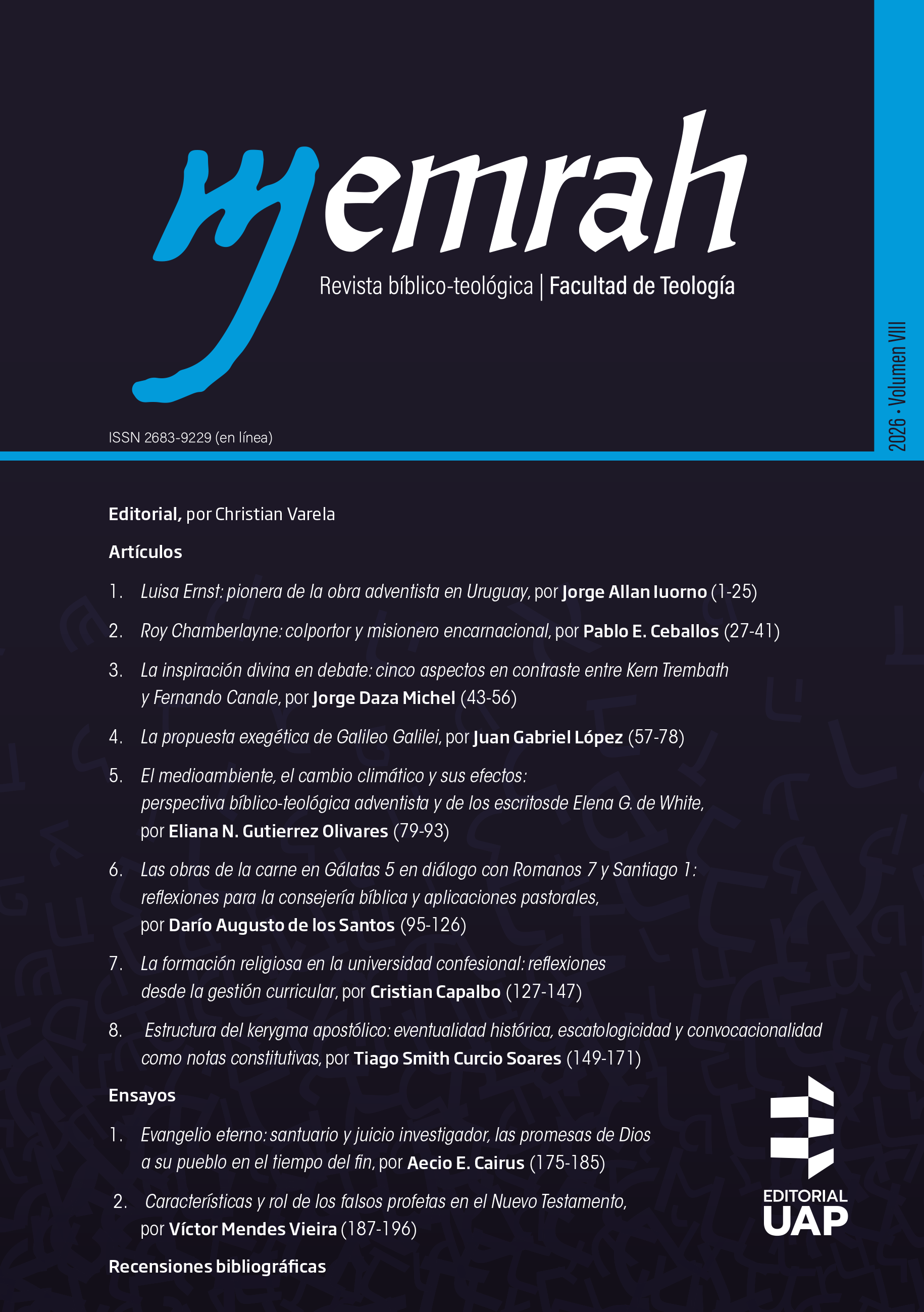
Structure of the Apostolic Kerygma: Historical Contingency, Eschatological Character, and Conationalityas Constitutive Features
DOI:
https://doi.org/10.56487/3w9nx508Keywords:
Apostolic kerygma — κήρυγμα, κῆρυξ, κηρύσσω — Herald — Parousia — Eschatology — Lexicographical análisis — Eschatological proclamation — Proclamation method — C. H. Dodd — R. BultmannAbstract
The debate over the nature of the apostolic kerygma, initiated by C. H. Dodd (1936) and radicalized by Bultmann, has systematically lacked a lexicographical foundation.
Dodd and his critics operate with a notion of kerygma as a pre-constructed theological category, without examining the morphological and semantic data of the lexical group κῆρυξ / κηρύσσω / κήρυγμα. This article proposes to fill that gap through a systematic lexicological analysis of the semantic field, from Classical Greek to the apostolic fathers. The analysis demonstrates that κήρυγμα morphologically denotes
an objectified content that can be transmitted as a normative unit, that the κῆρυξ is invariably an agent commissioned from outside, and that the demand for a response imposed by the κήρυγμα rests on the authority of the sovereign who sends him, not on the rhetoric of the proclaimer. On this basis, three constitutive features
of the apostolic kerygma are identified: historical contingency, structural eschatological nature, and urgent convocational character. The consistency of this structure throughout the Old Testament, intertestamental literature, and pre-Pauline formulas
confirms that the kerygma was transmitted as a normative unit, not constructed
progressively, thereby providing a textual basis for resolving the Dodd–Bultmann
debate from within the New Testament. An analysis of the complete triad κῆρυξ /
κηρύσσω / κήρυγμα further demonstrates that the kerygmatic structure is functionally
operative: κηρύσσω allows for legitimate methodological variation, but the dissociation
between method and message produces structurally fragile connections, which
offers a kerygmatic criterion for evaluating missiological praxis.
Downloads
Downloads
Published
Issue
Section
License
Copyright (c) 2026 Tiago Smith Curcio Soares

This work is licensed under a Creative Commons Attribution-NonCommercial-ShareAlike 4.0 International License.