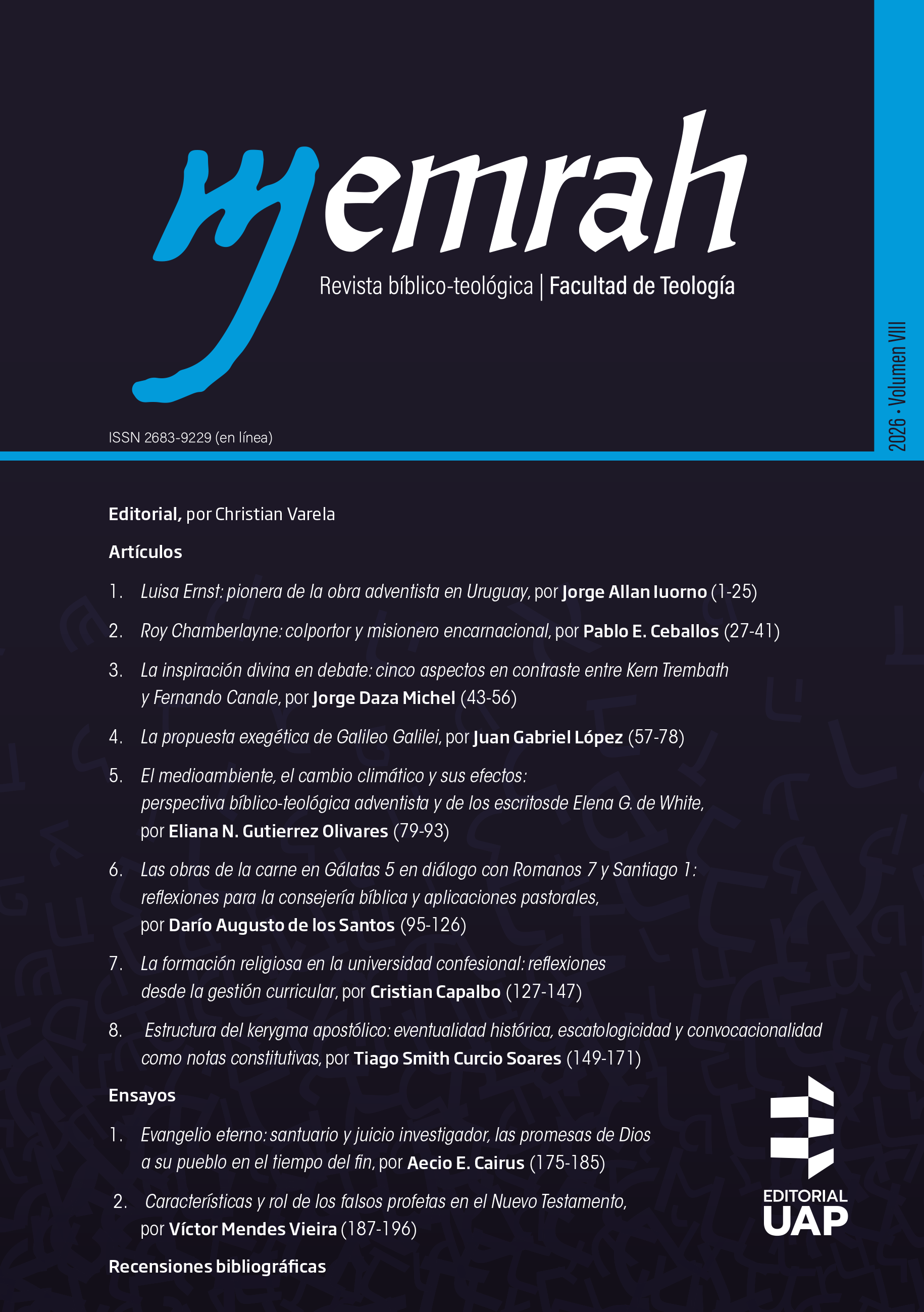
Divine Inspiration Under Debate: Five Contrasting Aspects between Kern Trembath and Fernando Canale
DOI:
https://doi.org/10.56487/0k85vc48Keywords:
Biblical inspiration — Biblical authority — Plenary inspiration — Kern Trembath — Fernando CanaleAbstract
This article critically examines the models of biblical inspiration proposed by Kern Trembath and Fernando Canale to determine which offers a more consistent understanding of Scripture’s divine origin, authority, and cognitive function. The analysis contrasts five issues: inspiration as a communal function or divine origin; its subjective or objective nature; the role of the human recipient in revelation; dependence on the Holy Spirit; and the validity of plenary inspiration. Trembath develops an inductivist, functional-community model that privileges the community’s interpretive experience. Although he recognizes divine initiative and the Spirit’s guidance, he assigns the recipient a primary role and questions the equal inspired authority of all biblical passages. In contrast, Canale formulates a historical-cognitive model that begins with God as the revealing agent and regards Scripture as an objective, universal, and coherent source of theological knowledge. His proposal maintains that human participation and literary diversity do not entail degrees of inspiration, because the Spirit preserves the fidelity of the divine message. These differences directly affect biblical authority, interpretation, and Christian faith in changing contexts. The study ultimately concludes that Canale’s approach more coherently integrates divine revelation and human mediation, safeguarding the unity, authority, and doctrinal stability of the entire biblical canon.
Downloads
Downloads
Published
Issue
Section
License
Copyright (c) 2026 Jorge Daza Michel

This work is licensed under a Creative Commons Attribution-NonCommercial-ShareAlike 4.0 International License.