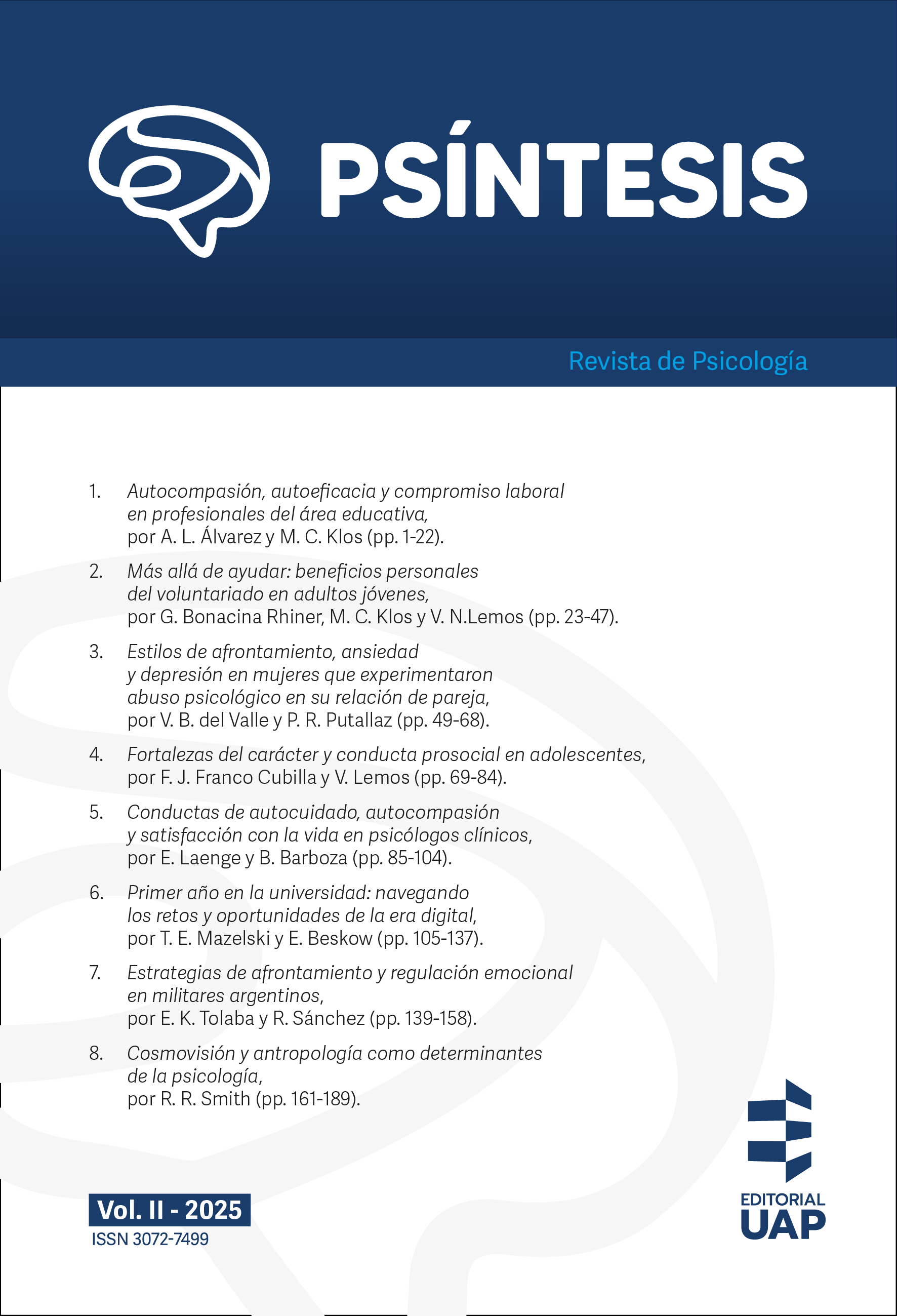
Coping Strategies and Emotional Regulation in Argentine Military Personnel
DOI:
https://doi.org/10.56487/64tz2t54Keywords:
Coping strategies — Emotional regulation — Argentine militaryAbstract
Introduction. The objective of this study was to analyze the coping and emotion regulation strategies used by Argentine military personnel, and to explore their variations according to sex, age, years of service, and number of relocations. Method. The Spanish version of the Ways of Coping Checklist (WCC), adapted by Richaud de Minzi and Sacchi (1995), and the Emotion Regulation Questionnaire (ERQ) by Gross (1998), Argentine adaptation by Andrés and Urquijo (2011), were applied. The sample consisted of 113 military personnel (66 men and 48 women), selected through non-probabilistic sampling. Results. Cognitive reappraisal (M=5.24, DE=1.05) and logical analysis (M=2.34, DE=0.45) were the most used strategies. No significant differences were found by sex in coping (F[9,10]=1.25, p=0.28) or emotion regulation (F[2,11]=3.05, p=0.05). However, with increasing age (F[18,20]=2.83, p=0.001) and seniority (F[18,20]=3.16, p=0.001), there was a greater use of proactive strategies and less emotional suppression. The number of relocations did not significantly influence the specific use of coping strategies (F[18,20]=2.37, p=0.002) nor emotion regulation (F[4,22]=1.39, p=0.237). Conclusions. Overall, military personnel tended to employ proactive, problem-focused strategies influenced by their institutional training. Relocations were not perceived as emotionally stressful events, suggesting their normalization within military culture.
Downloads
References
Abdala, V. D. J. C., y Muñoz, R. G. (2018). Familias de militares en México: bienestar objetivo y bienestar subjetivo; bases para un debate. Latinoamericana de Estudios de Familia, 10(2), 87–104.
Adler, A. B., Bliese, P. D., McGurk, D., Hoge, C. W., y Castro, C. A. (2009). Battlemind debriefing and battlemind training as early interventions with soldiers returning from Iraq: Randomization by platoon. Journal of Consulting and Clinical Psychology, 77(5), 928–940. https://doi.org/10.1037/a0016877
Andrés, M. L., y Urquijo, S. (2011). Cuestionario de Regulación Emocional: tra ducción y adaptación rioplatense para la Argentina Revisado (CRE-AR). CIMEPB−UNMP−CONICET.
Azzolini, S., Bail Pupko, V., Vidal, V. A., y Nistal, M. (2011). Estrategias de afrontamiento ante el cambio de pautas culturales y su relación con síntomas depresivos en alumnos ingresantes a formación militar. III Congreso Internacional de Investigación y Práctica Profesional en Psicología, XVIII Jornadas de Investigación, VII Encuentro de Investigadores en Psicología del MERCOSUR; Universidad de Buenos Aires.
Badaró, M. (2006). Identidad individual y valores morales en la socialización de los futuros oficiales del Ejército Argentino. Avá. Revista de Antropología, (9), 60–76. https://www.redalyc.org/pdf/1690/169014140005.pdf
Bail Pupko, V., Becerra, L., Depaula, P., y Castillo, S. (2018). Enfermeros militares: entrenamiento en primeros auxilios psicológicos y afrontamiento ante catástrofes. CEFA Digital. http://www.cefadigital.edu.ar/handle/1847939/1513
Bail Pupko, V., Nistal, M., Vidal, V. A., y Lara, A. F. (2012). Salud psicofísica y su relación con las estrategias de afrontamiento en jóvenes durante el primer año de formación militar: un estudio longitudinal. IV Congreso Internacional de Investigación y Práctica Profesional en Psicología, XIX Jornadas de Investigación, VIII Encuentro de Investigadores en Psicología del MERCOSUR; Universidad de Buenos Aires.
Bautista Escobar, A. L. (2019). Estrategias de afrontamiento y estrés laboral en el personal militar en la Unidad Operativa Industria Naval [tesis de grado, Universidad César Vallejo].
Becerra, L., y Bail Pupko, V. (2021). Estrategias de afrontamiento en enfermeros militares durante la pandemia. Congreso Internacional de Investigación y Práctica Profesional en Psicología. Universidad de Buenos Aires.
Becerra, L., y Gelvan de Veinsten, S. B. (2010). Estudios preliminares de la aplicación del cuestionario de autoevaluación emocional (CAE) en población militar. REOP, 21(2), 503–524.
Bello Castillo, I., Martínez Camilo, A. L., Peterson Elías, P. M., y Sánchez Vincitore, L. V. (2021). Estrategias de afrontamiento: efectos en el bienestar psicológico de los universitarios durante la pandemia del COVID-19. Ciencia y Sociedad, 46(4). https://hacer.org/10.51862/046
Billings, A. G., y Moos, R. H. (1982). The role of coping responses and social resources in attenuating the stress of life events. Journal of Behavioral Medicine, 4(2). https://doi.org/10.1007/BF00844267
Britt, T. W., Adler, A. B., Sawhney, G., y Bliese, P. D. (2017). Coping strategies as moderators of the association between combat exposure and PTSD symptoms. Journal of Traumatic Stress, 30(5), 491–501. https://doi.org/10.1002/jts.22221
Cabrera García, V. E., Rodríguez Casallas, M. C., Velásquez Ladino, L. D., y Garzón Cruz, Y. T. (2021). Estabilidad marital en matrimonios distanciados por la misionalidad de las Fuerzas Militares de Colombia. Revista Científica General José María Córdova, 19(33), 159–177. https://doi.org/10.21830/19006586.710
Casós Cumpa, C. L. (2016). Estrategias de afrontamiento y agresividad en soldados del servicio militar voluntario de Trujillo [tesis de licenciatura, Universidad César Vallejo].
Chaves Castaño, L., y Orozco Rosado, A. M. (2015). Estilos de personalidad y estrategias de afrontamiento al estrés en soldados. Revista de Psicología Universidad de Antioquia, 7(1). https://repositorio.uchile.cl/manejar/2250/8471671
Custodio, J., Jaime, M. F. Z., Medrano, L. A., y González, R. (2021). Trait Meta-Mood Scale-24: estructura factorial y validez en estudiantes argentinos. Bordón. Revista de Pedagogía, 73(3), 63–80.
Da Costa, S., Delfino, G. I., Muratori, M., y Beramendi, M. R. (2018). Afrontamiento y regulación emocional ante una orden antinormativa. Latinoamericana de Psicología Positiva, 4, 76–95.
Donoso Rodríguez, D. (2024). Preparación psicológica en las Fuerzas Armadas. Ministerio de Defensa de España.
Ejército Argentino. (2019). La mujer en el ejército. https://www.ejército.mil.ar/
González, M. (2020). Estrategias de afrontamiento que predicen mayor resiliencia. Revista de Psicología, 46(4). https://doi.org/10.10.51862/046.4.2021
Gross, J. J. (1998). The emerging field of emotion regulation: An integrative review. Review of General Psychology, 2(3), 271–299.
Gross, J. J., y John, O. P. (2003). Individual differences in two emotion regulation processes. Journal of Personality and Social Psychology, 85(2), 348.
Gross, J., Richards, J., y John, O. (2006). Emotion regulation in everyday life. En D. K. Synder, J. A. Simpson, y J. N. Hugues (eds.), Emotion regulation in couples and families (pp. 13–35). APA.
Gross, J. J., y Thompson, R. A. (2007). Emotion regulation: Conceptual foundations. En J. J. Gross (ed.), Handbook of emotion regulation (pp. 3–25). Guilford Press.
Gross, J. J., Sheppes, G., y Urry, H. L. (2011). Emotion generation and emotion regulation: A distinction we should make. Cognition and Emotion, 25(5).
Gutiérrez La Cruz, J. M. (s. f.). Alexitimia y regulación emocional en militares hospitalizados de la zona VRAEM [tesis de licenciatura, Pontificia Universidad Católica del Perú].
Herrera, V., y Guarino, L. (2008). Sensibilidad emocional, estrés y salud percibida en marinos venezolanos. Universitas Psychologica, 7(1), 185–198.
Jiménez Ruiz, A., Marín, A., y Martínez, M. (2021). Responsabilidad penal de las empresas matrices. Revista de Estudios Europeos, 77, 23–45.
Johnsen, B. H., Laberg, J. C., y Eid, J. (1998). Coping strategies and mental health problems in a military unit. Military Medicine, 163(9), 599–602.
Korem, N., Ben-Zion, Z., Spiller, T. R., Duek, O. A., Harpaz-Rotem, I., y Pietrzak, R. H. (2023). Avoidant coping and trauma in U.S. military veterans. Journal of Affective Disorders, 339, 89–97.
Lazarus, R. S., y Folkman, S. (1984). Estrés, valoración y afrontamiento. Springer.
Lazarus, R. S., y Folkman, S. (1986). Estrés y procesos cognitivos. Martínez Roca.
Ley de Salud Mental 26657. Ministerio de Salud de la Nación Argentina. (2022). https://www.argentina.gob.ar/salud/saludmental
Loaiza, O., y Posada, J. L. (2016). Psicología militar: Conceptualización e investigaciones contemporáneas. PSIENCIA. Revista Latinoamericana de Ciencia Psicológica, 8(2), 1–20.
Macías, M. A., Madariaga Orozco, C., Valle Amarís, M., y Zambrano, J. (2013). Estrategias de afrontamiento individual y familiar frente al estrés psicológico. Psicología desde el Caribe, 30(1), 123–145.
McCubbin, M., y McCubbin, H. (1993). Family coping with health crises: The resiliency model. En C. Danielson, B. Hamel-Bissell, y P. Winstead-Fry (eds.), Families, health and illness. Mosby.
Vargas Gutiérrez, M. R., y Muñoz-Martínez, M. A. (2013). La regulación emocional: precisiones conceptuales desde la perspectiva conductual. Psicología USP, 24(2), 225–240. https://www.redalyc.org/articulo.oa?id=305128932003
Moore, S. A., Zoellner, L. A., y Mollenholt, N. (2008). Are expressive suppression and cognitive reappraisal associated with stress-related symptoms? Behaviour Research and Therapy, 46(9), 993–1000. https://doi.org/10.1016/j.brat.2008.05.001
Morales Rins, J. (2018). Argentina: estrategia de seguridad nacional y roles de las Fuerzas Armadas. Revista de Estudios en Seguridad Internacional, 4(1), 73–88. https://doi.org/10.18847/1.7.5
Morgan, J. K., Hourani, L., y Tueller, S. (2017). Coping and mental health in military personnel. Military Medicine, 182(3–4), e1620–e1627.
Nolen-Hoeksema, S., y Aldao, A. (2011). Gender and age differences in emotion regulation strategies. Personality and Individual Differences, 51(6), 704–708.
Olson, D. H. (2011). Marriage and families: Intimacy, diversity, and strengths (11.ª ed.). McGraw-Hill.
Olson, D., McCubbin, H., y Barnes, H. (1983). Families: What makes them work. SAGE.
Ospina Stepanian, A. (2016). Síntomas, niveles de estrés y estrategias de afrontamiento en estudiantes de formación militar [tesis de maestría, Universidad Católica de Colombia].
Pietrzak, R. H., Johnson, D. C., Goldstein, M. B., Malley, J. C., y Southwick, S. M. (2009). Psychological resilience and postdeployment social support protect against PTSD. Depression and Anxiety, 26(8), 745–751. https://doi.org/10.1002/da.20558
Richaud de Minzi, M. C., y Sacchi, C. (2001). The effect of inaplicable items in the factor structure of the Ways of Coping Questionnaire Spanish version. Psychological Reports, 88, 115–122.
Rojas Sosa, J. A., y Uribe Bermejo, D. N. (2021). Regulación emocional y estrés laboral en personal militar [tesis de licenciatura, Facultad de Derecho y Humanidades, Escuela Profesional de Psicología].
Troy, A. S., Wilhelm, F. H., Shallcross, A. J., y Mauss, I. B. (2010). Seeing the silver lining: Cognitive reappraisal and stress. Emotion, 10(6), 783–795. https://doi.org/10.1037/a0020262
Zeidner, M., y Endler, N. S. (1995). Manual de afrontamiento: teoría, investigación y aplicaciones (vol. 195). John Wiley & Sons.
Downloads
Published
Issue
Section
License
Copyright (c) 2025 Evelin Karen Tolaba, Raúl Sánchez

This work is licensed under a Creative Commons Attribution-NonCommercial-ShareAlike 4.0 International License.