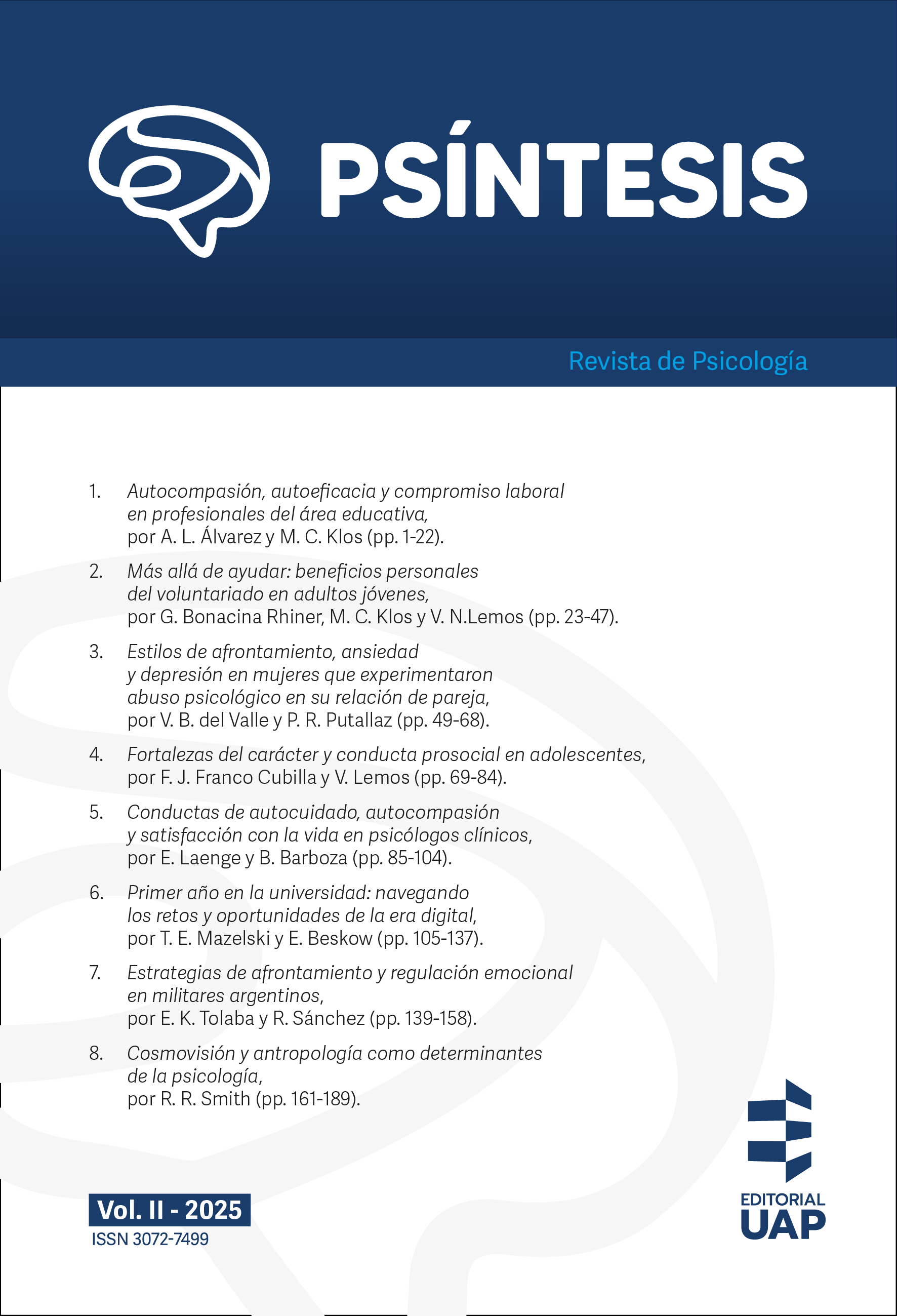
First Year at College: Navigating the Challengesand Opportunities of the Digital Era
DOI:
https://doi.org/10.56487/a4awsw08Keywords:
Screen use — University students — Coping strategies — Technological challenges — Digital opportunitiesAbstract
This study explored the screen use habits of first-year university students through a narrative qualitative methodology. Data was collected via interviews with 17 incoming students from various academic disciplines. Two primary patterns of screen use emerged: sequential and, at times, compulsive digital zapping on social networks, and the use of digital devices as substitutes for the paper-based materials commonly used in secondary education. Students reported feeling vulnerable to the constant pull of digital devices, which often resulted in procrastination, guilt, and social isolation. To counter these effects, they employed various strategies, including distancing themselves from their devices, setting alarms, managing notifications, and, when necessary, turning off their devices entirely. Despite their efforts to harness the potential of technology, students frequently resorted to quick answers found on social media or generative AI chats rather than engaging with academic databases—ultimately limiting opportunities for deep and critical learning. These findings highlight the need for greater guidance, mentoring, and support to help students optimize the academic and psycho-emotional benefits of digital technologies.
Downloads
References
Alexander, B. (2017). The new digital storytelling: Creating narratives with new media. ABC-CLIO.
Anderson, J., y Rainie, L. (2018). The future of well-being in a tech-saturated world. Pew Research Center.
Aufa, A., Mustansyir, R., y Maharani, S. (2020). What is smartphone? Philosophical perspective: Reflection on the use of smartphone in the new normal life. Research, Society and Development, 9(9), e116996991. http://doi.org/10.33448/rsd-v9i9.6991
Bozsik, F., Rozgonjuk, D., Schaub, M. P., y Montag, C. (2021). The association between smartphone use and concentration, mental health, and physical activity: A daily diary study. Computers in Human Behavior, 115(3), 106618.
Braun, V., y Clarke, V. (2013). Successful qualitative research: A practical guide for beginners. SAGE.
Celis Bueno, C. (2020). La economía de la atención: del ciber-tiempo al tiempo cinemático. Revista Hipertextos, 8(14), 59–71. https://doi.org/10.24215/23143924e019
Chárriez Cordero, M. (2012). Historias de vida: Una metodología de investigación cualitativa. Revista Griot, 5(1), 50–67. https://revistas.upr.edu/index.php/griot/article/view/1775
Clandinin, J., Lessard, S., y Caine, V. (2018). La ética relacional de la indagación narrativa. Routledge, Taylor & Francis.
Clandinin, J. (2016). Participar en la indagación narrativa. Routledge.
Creswell, J. (2013). Qualitative inquiry & research design: Choosing among five approaches. SAGE.
De Piero, A., et al. (2015). Hábitos de consumo del estudiante universitario: el caso del centro universitario del sur, de la Universidad de Guadalajara. Nova Scientia, 7(13), 45–60.
Escobar, J., y Bonilla-Jiménez, F. I. (2017). Grupos focales: una guía conceptual y metodológica. Cuadernos Hispanoamericanos de Psicología, 9(1), 51–67. https://gc.scalahed.com/recursos/files/r161r/w25267w/guiagruposfocales.pdf
Folgueiras Bertomeu, P. (2016). La entrevista [documento]. https://diposit.ub.edu/dspace/bitstream/2445/99003/1/entrevista%20pf.pdf
Dewey, J. (1958). Experience and nature (2.ª ed.). Dover Publications.
Giedd, J. N. (2020). El cerebro adolescente y el encanto natural de los medios digitales. Diálogos en Neurociencia Clínica, 22(2), 127–133. https://doi.org/10.31887/DCNS.2020.22.2/jgiedd
Giraldo-Luque, S., y Fernández-Rovira, C. (2020). Redes sociales y consumo digital en jóvenes universitarios: economía de la atención y oligopolios de la comunicación en el siglo XXI. Profesional de la Información, 29(5), e290528. https://doi.org/10.3145/epi.2020.sep.28
Giraldo-Luque, A., y Fernández-Rovira, J. I. (2020). Consumo de redes sociales y su impacto en la atención y el bienestar psicológico en jóvenes universitarios. Revista de Psicología Universitaria, 15(2), 123–135.
Hurst, J., Dittmar, H., Banerjee, R., Bond, R., y Kasser, T. (2018). The relationship between materialistic values and environmental attitudes and behaviors: A meta-analysis. Journal of Environmental Psychology, 55(1), 40–50.
Jasso Medrano, L. M., y López Rosales, J. (2017). Uso intensivo de redes sociales y su relación con problemas de memoria de trabajo en estudiantes universitarios. Estudios de Educación Superior, 10(1), 45–58.
Junco, R., y Cotten, S. R. (2012). No A 4 U: The relationship between multitasking and academic performance. Computers & Education, 59(2), 505–514.
Katz, V. S., y Kravetz, D. (2019). Digital inequality and developmental trajectories: Incorporating individual, family, and neighborhood factors into digital inequality research. New Media & Society, 21(5), 1181–1200.
Kuss, D. J., y Griffiths, M. D. (2011). Online social networking and addiction—A review of the psychological literature. International Journal of Environmental Research and Public Health, 8(9), 3528–3552.
Lian, S. Lei, Sun, X. Jun, Zhou, Z. Kui, Fan, C. Ying, Niu, G. Feng, y Liu, Q. Qi. (2018). Social networking site addiction and undergraduate students’ irrational procrastination: The mediating role of social networking site fatigue and the moderating role of effortful control. PLOS ONE, 13(12). https://doi.org/10.1371/JOURNAL.PONE.020816
Lieblich, A., Tuval-Mashiach, R., y Zilber, T. (1998). Investigación narrativa: Lectura, análisis e interpretación. Salvia.
Lincoln, Y. S., y Guba, E. G. (1985). Indagación naturalista. SAGE.
Lombardo, M. D. (2022). Adicción a las redes sociales y procrastinación académica en estudiantes universitarios y terciarios del AMBA [tesis de licenciatura, Universidad Abierta Interamericana]. https://repositorio.uai.edu.ar/handle/123456789/1284
López de la Madrid, M. C., et al. (2015). Hábitos de consumo del estudiante universitario. Nova Scientia, 7(13), 45–60.
López-Gil, K. S., y Ramírez Osorio, L. S. (2020). Concepciones de ingresantes universitarios sobre la multitarea en entornos digitales. Zona Próxima, (33), 3–26.
Maldonado Berea, S., García González, J., y Sampedro-Requena, B. E. (2019). Hábitos de consumo de redes sociales en estudiantes universitarios: Un estudio de caso. Revista de Investigación Educativa, 12(3), 201–215.
Meier, A., Reinecke, L., y Meltzer, C. E. (2016). “Facebocrastination”? Predictors of using Facebook for procrastination and its effects on students’ well-being. Computers in Human Behavior, 64(3), 65–76.
Mulholland, J., y Wallace, J. (2003). Fuerza, compartir y servicio: Restorying y legitimación de textos de investigación. Revista Británica de Investigación Educativa, 29(1), 5–23. http://doi.org/10.1080/0141192032000057348
Muñoz-De-Mier, M., et al. (2017). Estrés académico y hábitos de consumo en estudiantes universitarios. Revista de Psicología Educativa, 25(2), 89–102.
Mustapha, I., Thuy Van, N., Shahverdi, M., Qureshi, M., y Khan, N. (2021). Effectiveness of digital technology in education during COVID-19 pandemic: A bibliometric analysis. International Journal of Interactive Mobile Technologies (IJIM), 15(8), 136–154. http://dx.doi.org/10.3991/ijim.v15i08.20415
Núñez-Guzmán, R. L., y Cisneros-Chavez, B. C. (2019). Adicción a redes sociales y procrastinación académica en estudiantes universitarios. Nuevas Ideas en Informática Educativa, 15, 114–120.
Otzen, T., y Manterola, C. (2017). Técnicas de muestreo sobre una población a estudio. International Journal of Morphology, 35(1), 227–232.
Ranchal García, S. (2023). Influencia del consumo y el policonsumo al rendimiento académico y al autoconcepto de jóvenes universitarios: revisión sistemática. Universidad de Granada.
Ravitch, S. M., y Carl, N. M. (2016). Investigación cualitativa: puente entre lo conceptual, lo teórico y lo metodológico. SAGE.
Reátegui, N. E. S., y Álvarez, P. M. B. (2023). Uso de redes sociales y procrastinación en estudiantes universitarios: una revisión sistemática. Revista Peruana de Investigación e Innovación Educativa, 3(1), e24035–e24035.
Reyes, T. (Diciembre de 1999). Métodos cualitativos de investigación: los grupos focales y el estudio de caso. Forum Empresarial, 4(2), 74–87.
Rodríguez, J., et al. (2001). Consumo responsable en estudiantes de pregrado de tres universidades. Revista de Estudios Sociales, 10(2), 67–85.
Rosen, L. D., Whaling, K., Carrier, L. M., Cheever, N. A., y Rokkum, J. (2013). The media and technology usage and attitudes scale: An empirical investigation. Computers in Human Behavior, 29(6), 2501–2511.
Shenton, A. K. (2004). Estrategias para asegurar la confiabilidad en proyectos de investigación cualitativa. Educación para la Información, 22(2), 63–75. http://doi.org/10.3233/EFI-2004-22201
Steel, P. (2007). The nature of procrastination: A meta-analytic and theoretical review of quintessential self-regulatory failure. Psychological Bulletin, 133(1), 65–94.
Tice, D., y Baumeister, R. (1997). Estudio longitudinal de la procrastinación, el rendi miento, el estrés y la salud: los costes y beneficios del holgazanería. Psychological Science. 8, 454–458. http://doi.org/10.1111/j.1467-9280.1997.tb00460.x
Villani, D., Cipresso, P., Gatti, E., y Riva, G. (2018). The effects of a mobile-based in tervention on the reduction of stress-related symptoms. Computers in Human Behavior, 87(1), 299–310.
Zallocchi, V., y Perret Marino, S. (2019). Uso de tecnologías digitales en la educación superior: beneficios y desafíos. Journal of Educational Technology, 8(4), 234–248.
Downloads
Published
Issue
Section
License
Copyright (c) 2025 Tomas Elías Mazelski, Edgar Beskow

This work is licensed under a Creative Commons Attribution-NonCommercial-ShareAlike 4.0 International License.