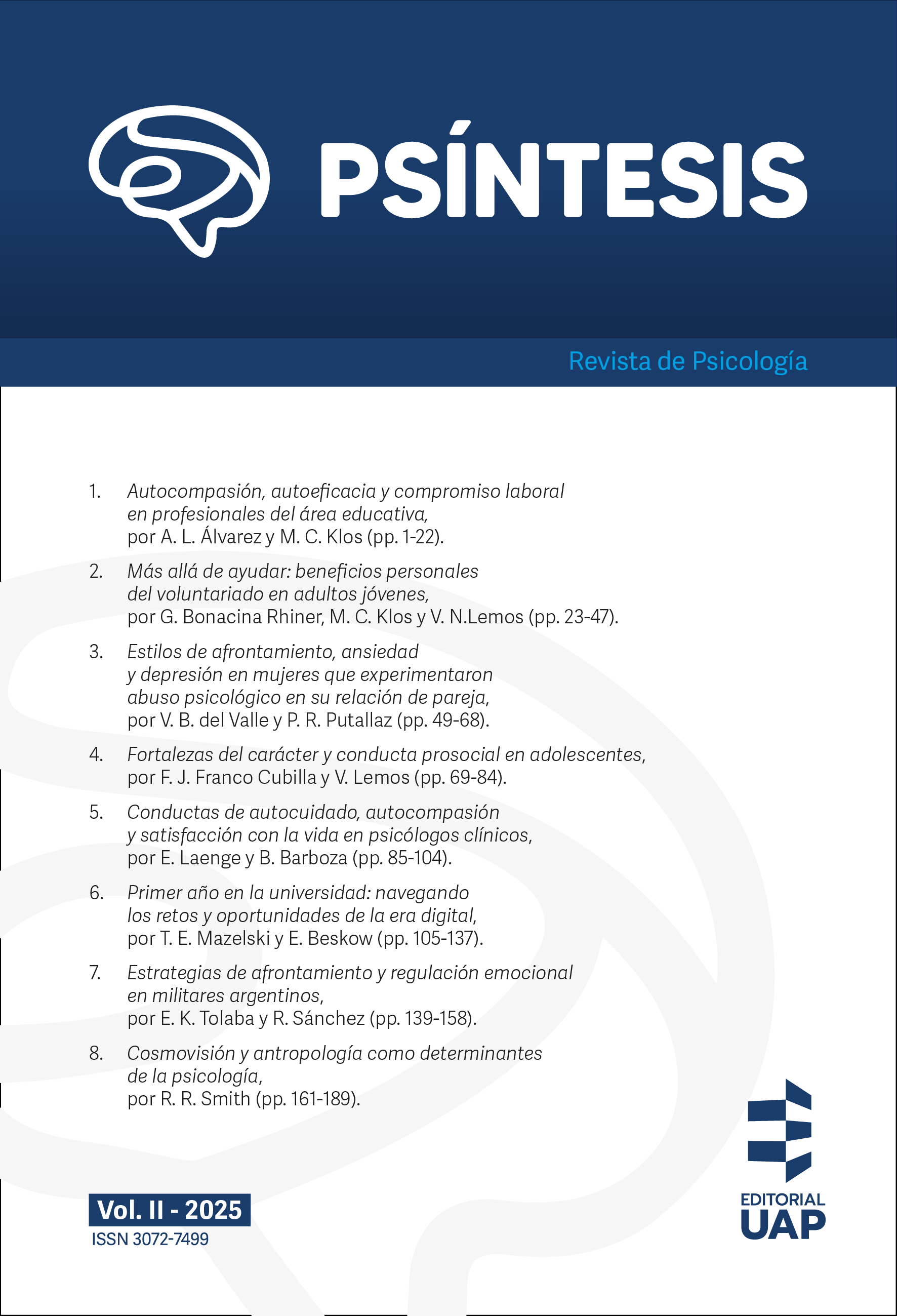
Self-Care Behaviors, Self-Compassion and Life Satisfactionin Clinical Psychologist
DOI:
https://doi.org/10.56487/x8xbf606Keywords:
Self-compassion — Satisfaction with life — Self-care behaviors — Psychological wellbeing — Professional burnout — Clinical psychologistsAbstract
Introduction. The growing relevance of psychological well-being in mental health professionals has led to the identification of key variables that influence their quality of life and prevent burnout, particularly in a profession that faces high levels of stress and emotional exhaustion. Therefore, the objective of this study was to analyze the role of self-care behaviors and self-compassion in predicting life satisfaction in clinical psychologists. Method. The non-probabilistic sample was composed of 105 clinical psychologists from Argentina, of both sexes, aged between 23 and 69 years (SD=10.16). Of the participants, 77.1% were women (n=81) and 22.9% were men (n=24). Therapists completed the Self-Care Behavior Scale for Clinical Psychologists (EAP), the Brief Self-Compassion Scale (SCS - SF) and the Satisfaction with Life Scale (SWLS). Results. Block regression analysis showed that the general model explained 21% of the variance in life satisfaction. Self-care behaviors explained 7% of the variance in the first block, while self-compassion added 13% in the second block. The variables age, years of experience and number of patients per week added only 1% of variance in the third block. In summary, the variable with the highest predictive weight was the mindfulness vs. over-identification of self-compassion subscale (β=0.39, p=0.006), followed by self-care behaviors (β=0.20, p=0.028). Conclusions. These findings reinforce the importance of self-care and self-compassion, particularly in its mindfulness component, as key factors for life satisfaction in clinical psychologists. Promoting these practices could contribute significantly to well-being and burnout prevention in this professional group.
Downloads
References
Alavijeh, M. S., Zandiyeh, Z., y Moeini, M. (2021). The effect of self-care self-efficacy program on life satisfaction of the Iranian elderly. Journal of Education and Health Promotion, 10, art. 167. https://doi.org/10.4103/jehp.jehp_928_20
Andrade Fariño, J., y Sotomayor Reinoso, C. (2023). Autocuidado del psicólogo clínico, que aporta a la línea de investigación cuantitativa [tesis de maestría]. Universidad Estatal de Milagro. http://repositorio.unemi.edu.ec/xmlui/handle/123456789/7029
Aranda Auserón, G., Elcuaz Viscarret, M. R., Fuertes Goñi, C., Güeto Rubio, V., Pascual Pascual, P., y García de Galdeano, E. S. de M. (2018). Evaluación de la efectividad de un programa de mindfulness y autocompasión para reducir el estrés y prevenir el burnout en profesionales sanitarios de atención primaria. Atención Primaria, 50(3), 141–150. https://doi.org/10.1016/j.aprim.2017.03.009
Araya, C., y Moncada, L. (2016). Autocompasión: origen, concepto y evidencias preliminares. Revista Argentina de Clínica Psicológica, 25(1), 67–78.
Barnard, L. K., y Curry, J. F. (2011). Self-compassion: Conceptualizations, correlates, & interventions. Review of General Psychology, 15(4), 289–303. https://doi.org/10.1037/a0025754
Betta Olivares, R., Morales Messerer, G., Rodríguez Ureta, K., y Guerra Vio, C. (2007). La frecuencia de emisión de conductas de autocuidado y su relación con los niveles de estrés traumático secundario y de depresión en psicólogos clínicos. Pensamiento Psicológico, 3(9), 9–19.
Cabañero Martínez, M. J., Richart Martínez, M., Cabrero García, J., Orts Cortés, M., Reig Ferrer, A., y Tosal Herrero, B. (2004). Fiabilidad y validez de la Escala de Satisfacción con la Vida de Diener en una muestra de mujeres embarazadas y puérperas. Psicotema, 16(3), 448–455.
Castro Solano, A. (2010). Fundamentos de psicología positiva. Paidós.
Cazabat, E. (2002). Desgaste por empatía: las consecuencias de ayudar [documento]. https://www.psicotrauma.com.ar/cazabat/archivos/23-Cazabat-Desgaste%20por%20Empatia.pdf
Chew, L. C., y Ang, C. S. (2023). The relationship among quiet ego, authenticity, self-compassion and life satisfaction in adults. Current Psychology, 42(7), 5254–5264.
Dehkordi, R. P. (2023). Fatigue, self-compassion and life satisfaction in nurses [tesis doctoral, Universidad de Salamanca].
Diaz, M. S., González, M. L., y Kaucher, M. B. (2021). La importancia del autocuidado en psicoterapeutas desde una perspectiva conductual contextual en tiempos de pandemia: desgaste por empatía y burnout [conferencia]. XIII Congreso Internacional de Investigación y Práctica Profesional en Psicología. XXVIII Jornadas de Investigación. XVII Encuentro de Investigadores en Psicología del MERCOSUR. III Encuentro de Investigación de Terapia Ocupacional. III Encuentro de Musicoterapia. Facultad de Psicología, Universidad de Buenos Aires, Argentina. https://www.aacademica.org/000-012/653
Diener, E. (1984). Subjective well-being. Psychological Bulletin, 95(3), 542–575.
Diener, E., Emmons, R., Larsen, R., y Griffin, S. (1985). The satisfaction with life scale. Journal of Personality Assessment, 49(1), 71–75. https://doi.org/10.1207/s15327752jpa4901_13
Diener, E., y Larsen, R. (1993). The experience of emotional well-being. En M. Lewis y J. M. Haviland (eds.), Handbook of emotions (pp. 404–405). Guilford Press.
Diener, E., Suh, E. M., Lucas, R. E., y Smith, H. L. (1999). Subjective well-being: Three decades of progress. Psychological Bulletin, 125(2), 276–302. https://doi.org/10.1037/0033-2909.125.2.276
Erci, B., Yilmaz, D., y Budak, F. (2017). Effect of self-care ability and life satisfaction on the levels of hope in elderly people. Journal of Psychiatric Nursing, 8(2), 72–76. http://doi.org/10.14744/phd.2017.52714
Figley, Ch. R. (1999). Compassion fatigue: Toward a new understanding of the cost of caring. En B. H. Stamm (ed.), Secondary traumatic stress: Self-care issues for clinicians, researchers, and educators (pp. 3–28). Sidran Press.
Figley, Ch. R. (2002). Treating compassion fatigue. Brunner-Routledge.
Gancedo, M. (2008). Historia de la psicología positiva. En M. M. Casullo (comp.), Prácticas en psicología positiva. Lugar Editorial.
García Calderón, C. S. (2023). Autocompasión, satisfacción con la vida y esperanza en estudiantes de universidades privadas limeñas [tesis de grado]. Universidad Peruana de Ciencias Aplicadas.
Germer, C. K., y Siegel, R. D. (2012). Wisdom and compassion in psychotherapy: Deepening mindfulness in clinical practice. Guilford Press.
Guerra, C., Rodríguez, K., Morales, G., y Betta, R. (2008). Validación preliminar de la Escala de Conductas de Autocuidado para Psicólogos Clínicos. Psykhe, 17(2), 67–78. http://dx.doi.org/10.4067/S0718-22282008000200006
Hernández Montaño, A., y González Tovar, J. (2022). Modelo explicativo del autocuidado, la regulación emocional y el burnout en psicólogas en condición de aislamiento por COVID-19. Acta Colombiana de Psicología, 25(2), 90–103. https://www.doi.org/10.14718/ACP.2022.25.2.6
Hesse, A. R. (2002). Secondary trauma: How working with trauma survivors affects therapists. Clinical Social Work Journal, 30(3), 293–309. https://doi.org/10.1023/A:1016049632545
Jennings, L. K., y Tan, P. P. (2014). Self-compassion and life satisfaction in gay men. Psychological Reports, 115(3), 888–895.
Kazantzis, N., Whittington, C., y Dattilio, F. (2018). Meta-analysis of technology-assisted cognitive-behavioral therapy: Examination of therapeutic interactions and outcomes. Clinical Psychology Review, 32, 33–50.
Kim, C., y Ko, H. (2018). The impact of self-compassion on mental health, sleep, quality of life and life satisfaction among older adults. Geriatric Nursing, 39(6), 623–628.
Klos, M., Balabanian, C., y Lemos, V. (2019). Adaptación y validación de un cuestionario para evaluar la autocompasión en adolescentes y adultos jóvenes argentinos [conferencia]. XVII Reunión Nacional y VI Encuentro Internacional de la Asociación Argentina de Ciencias del Comportamiento; Misiones, Argentina.
Li, A., Wang, S., Cai, M., Sun, R., y Liu, X. (2021). Self-compassion and life satisfaction among Chinese self-quarantined residents during COVID-19 pandemic: A moderated mediation model of positive coping and gender. Personality and Individual Differences, 170, 110457.
Linley, P. A., y Joseph, S. (2007). Therapy work and therapists’ positive and negative well-being. Journal of Social and Clinical Psychology, 26(3), 385–403. https://doi.org/10.1521/jscp.2007.26.3.385
Lucas, R. E., Diener, E., y Suh, E. (1996). Discriminant validity of well-being measures. Journal of Personality and Social Psychology, 71(3), 616–628. https://doi.org/10.1037/0022-3514.71.3.616
Mantelou, A., y Karakasidou, E. (2017). The effectiveness of a brief self-compassion intervention program on self-compassion, positive and negative affect and life satisfaction. Psychology, 8(4), 590–610.
Mantelou, A., y Karakasidou, E. (2019). The role of compassion for self and others, compassion fatigue and subjective happiness on levels of well-being of mental health professionals. Psychology, 10, 285–304. https://doi.org/10.4236/psych.2019.103021
McCan, I. L., y Pearlman, L. A. (1990). Vicarious traumatization: A framework for understanding the psychological effects of working with victims. Journal of Traumatic Stress, 3(1), 131–149. https://doi.org/10.1007/BF00975140
Mikulic, I. M., Crespi, M., y Caballero, R. Y. (2019). Escala de satisfacción con la vida (SWLS): estudio de las propiedades psicométricas en adultos de Buenos Aires. Anuario de Investigaciones, XXVI. Universidad de Buenos Aires, Argentina.
Moreno Jiménez, B., Morante Benadero, M. E., Losada Novoa, M. M., Rodríguez Carvajal, R., y Garrosa Hernández, E. (2004). El estrés traumático secundario: evaluación, prevención e intervención. Terapia Psicológica, 22(1), 69–76.
Mülazım, Ö. Ç., y Eldeleklioğlu, J. (2016). What is the role of self-compassion on subjective happiness and life satisfaction? Journal of Human Sciences, 13(3), 3895–3904.
Neff, K. D. (2003). Self-compassion: An alternative conceptualization of a healthy attitude toward oneself. Self and Identity, 2(2), 85–101. https://doi.org/10.1080/15298860309032
Neff, K. D., y Pommier, E. (2013). The relationship between self-compassion and other-focused concern among college undergraduates, community adults, and practicing meditators. Self and Identity, 12(2), 160–176. https://doi.org/10.1080/15298868.2011.649546
Ortiz-Fune, C., Kanter, J. W., y Arias, M. F. (2020). Burnout in mental health professionals: The roles of psychological flexibility, awareness, courage, and love. Clínica y Salud, 31(2), 85–90. https://doi.org/10.5093/clysa2020a8
Padrós Blázquez, F. (2002). Disfrute y bienestar subjetivo: un estudio psicométrico de la gaudibilidad [tesis doctoral]. Universidad Autónoma de Barcelona.
Partarrieu, A. (2018). Síndrome de burnout en psicólogos clínicos y su relación con el perfeccionismo [conferencia]. X Congreso Internacional de Investigación y Práctica Profesional en Psicología. XXV Jornadas de Investigación. XIV Encuentro de Investigadores en Psicología del MERCOSUR. Facultad de Psicología, Universidad de Buenos Aires, Argentina.
Patsiopoulos, A. T., y Buchanan, M. J. (2011). The practice of self-compassion in counseling: A narrative inquiry. Professional Psychology: Research and Practice, 42, 301–307. https://doi.org/10.1037/a0024482
Pavot, W., y Diener, E. (1993). Review of the Satisfaction with Life Scale. Psychological Assessment, 5(2), 164–172. https://doi.org/10.1037/1040-3590.5.2.164
Reynoso Barron, N. X. (2019). Cansancio emocional y autocompasión: Implicancias en la satisfacción con la vida en estudiantes de derecho de una universidad privada de Lima Metropolitana [tesis de grado]. Pontificia Universidad Católica del Perú.
Richardson, J. I. (2001). Guidebook on vicarious trauma: Recommended solutions for anti-violence workers. Health Canadá.
Rodríguez de Behrends, M., Eidman, L., y Mántaras, F. (2021). Estudio de las propiedades psicométricas de la Escala de Autocompasión (EAC) en una muestra de profesionales de la salud mental en Argentina. Revista de Psicología, 17(34), 21–34. https://doi.org/10.46553/RPSI.17.34.2021.p21-34
Ruiz-Aranda, D., García-Silva, B., y Fenollar, J. (2024). Autocompasión del terapeuta y fatiga de la compasión: el papel mediador de la resiliencia. Anales de Psicología / Annals of Psychology, 40(2), 219–226. https://doi.org/10.6018/analesps.561691
Sabaitytė, E., y Diržytė, A. (2016). Psychological capital, self-compassion, and life satisfaction of unemployed youth. International Journal of Psychology: A Biopsychosocial Approach / Tarptautinis Psichologijos Žurnalas: Biopsichosocialinis Požiūris, (19).
Sabo, M. (2006). Compassion fatigue and nursing work: Can we accurately capture the consequences of caring work? International Journal of Nursing Practice, 12, 136–142. https://doi.org/10.1111/j.1440-172X.2006.00562.x
Sánchez Díaz, C. (2023). Burnout en psicólogos profesionales clínicos y sus factores personales y laborales [trabajo final de maestría, Comillas Universidad Pontificia]. Repositorio institucional. https://repositorio.comillas.edu/xmlui/bitstream/handle/11531/74220/TFM-Sanchez%20Diaz%2C%20Claudia.pdf?sequence=1&isAllowed=y
Seligman, M. (2011). Flourish: A visionary new understanding of happiness and well-being. Free Press.
Solís Ruiz, M., y Silva Castillo, L. (2022). Estrés traumático secundario y conductas de autocuidado en una muestra de psicólogos clínicos de Guadalajara. Revista de Psicología de la Universidad Autónoma del Estado de México, 11(24), 69–105. http://doi.org/10.36677/rpsicologia.v11i24.18540
Tang, S. M., Chen, S. W., y Wang, R. H. (2013). Establishing a model to assess the effects of school support and self-care behaviors on life satisfaction in adolescents with type 1 diabetes in Taiwan. Journal of Nursing Research, 21(4), 244–251.
Torregrosa-Ruiz, M., Gutiérrez, M., Alberola, S., y Tomás, J. M. (2021). A successful aging model based on personal resources, self-care, and life satisfaction. The Journal of Psychology, 155(7), 606–623.
Tuncay, F. Ö., y Avcı, D. (2020). Association between self-care management and life satisfaction in patients with diabetes mellitus. European Journal of Integrative Medicine, 35, 101099.
VandenBos, G. R. (Ed.). (2020). APA dictionary of psychology (2.ª ed.). American Psychological Association.
Vázquez, C. (2006). La psicología positiva en perspectiva. Papeles del Psicólogo, 27(1), 1–2.
Vélez Ramírez, A. (2014). Relación entre el bienestar psicológico de los psicoterapeutas y el vínculo terapéutico [tesis de maestría]. Universidad de Antioquia.
Vercet Revert, A. (2019). Autocompasión en una muestra de estudiantes universitarios: relación con variables psicológicas [tesis de maestría, Universidad Miguel Hernández]. Repositorio RediUMH. http://hdl.handle.net/11000/5911
World Health Organization. (1998). The Role of the pharmacist in self-care and self-medication: Report of the 4th WHO Consultative Group on the Role of the Pharmacist. The Hague, The Netherlands, 26–28 de agosto de 1998.
World Health Organization, Regional Office for South-East Asia. (2009). Self-care in the context of primary health care. WHO Regional Office for South-East Asia.
Yang, Y., Zhang, M., y Kou, Y. (2016). Self-compassion and life satisfaction: The mediating role of hope. Personality and Individual Differences, 98, 91–95.
Yáñez Montecinos, J. (2005). Constructivismo cognitivo: bases conceptuales para una psicoterapia breve basada en la evidencia [tesis de doctorado, Universidad de Chile]. Repositorio Académico Universidad de Chile.
Zarei, S. (2019). A mediating role of hope in the relationship between self-compassion and life satisfaction: A non-interventional study. Health Research Journal, 4(3), 159–167.
Downloads
Published
Issue
Section
License
Copyright (c) 2025 Edina Laenge, Beatriz Barboza

This work is licensed under a Creative Commons Attribution-NonCommercial-ShareAlike 4.0 International License.